Wednesday, May 26, 2010

A draft - revisited.

After leaving my home for a year abroad and living in various towns/cities in Ontario, I've returned to Hamilton. I'm not sure exactly what it is, but there's something about this city that makes me want to blog. Before posting new 'comments', here's a post I drafted over a year ago.

I've been newly inspired to blog. haha

A friend recently contacted me with an idea about writing to compliment the otherwise formality of science writing; thus began Postdoc at Large. Expanding on her first entry, imagination and function are tied in the blogger to shape the blog accordingly. This idea that the blog is an amorphous vehicle of seemingly infinite electronic possibility isn't new yet as a trend I'm aware some would argue it has past its use. Blogs may be going the way of the magazine or newspaper but I continue to suggest it as a simple way to practice one's voice. Small circulation - amongst an intimate group of peers - have historically been fruitful if we draw upon the diverse examples of Katherine Phillips' poetry and the beginnings of the avant garde poetry in the US.

That said, time has effected both examples differently: Phillip's poetry, accomplished and well circulated amongst the literati of her time, was forgotten or purposely buried by literature's boy's club (according to my colourful, thrift-shop loving, intimidatingly knowledgeable professor of fin de siecle literature), whereas the avant garde went (sadly) mainstream.

Returning to Postdoc at Large, I am cheered and encouraged when those around me start to flex their fingers. Recently, I attended my first workshop at Asian Arts Freedom School and though I am a pretender of sorts - being just a hair over the age limit - it was refreshing to be around youth who were unencumbered by the ever buzzing noise of academia whispering incessantly of the need to produceproduceproduce 'great work,' 'original work,' 'critical work.' If I had chosen graduate school with the thoughts that my writing might improve, I would have been very disappointed. There is still some soreness, because idealism and hope never seem to die, but realistically grad school has seemed less about sharing than I imagined.

I'm still writing papers and trying to wrap up this MA while helping run a business in downtown Hamilton but cultural studies, the arts and Hamilton are supremely complimentary topics! I'm looking forward to the intersections which will inspire me to post a comment.


Sunday, March 04, 2007

An "Important and Reoccuring Sub-plot:" Hornblower plays Affectionate Husband

The mirror caught Maria's reflection, and he forced himself back into the world again. she was standing pathetically looking at him, and he put down his razor, and took up the towel ans wiped the lather from his mouth. "Not a kiss since yesterday!" he said. "Maria, darling, don't you think you've been neglecting me?" ...And while he kissed her he thought of Atropos riding to her anchor out there in the river, and despised himself as a hypocritical lover."
(Hornblower and the "Atropos")

John Ford visited me at the store a few days ago. When I told him that Hornblower had become a 'real' captain he announced that he skips all the "mushy parts."

And for the first three books I didn't really understand what John was talking about; this was a series about a man in love with the sea (even though it made him violently sick and frequently led to mortal danger) and service. It was a Romance with the Sea - surely - but mushy?

That was, until Horatio got married to a sensitive, homely innkeeper's daughter. The first woman to show him kindness during a time of hard luck, Marie changes Horatio - military genius and gangly man of action - to Horry.

A pivotal point for sure, I haven't a clue why Forrester writes Horatio into Marie's stereotypically feminine arms. I could dismiss this mis-match as evidence that Forrester, like SO many male writers, simply can't imagine a 3D woman but there is a little authorial voice that peeks out once in a while to vote against such an easy dismissal. Either way, for all his lack of insight into the feminine mind I am in love with, and facinated by, this new dimension of Horatio as a BIG OL' FAKER.

I'm loving Horatio Hornblower.

Saturday, March 03, 2007

Quizzes count as reading right? And doing this Superhero Lover Quiz did induce me to post...


Wednesday, February 14, 2007


John Ford. We met when I told him he had the name of a poet.

I complain a lot. And I do so without prejudice. But bitching sometimes leads to good things.

John Ford and I met at the store about 8 months ago when he came in to buy his Players light large regular and his reading time snacks: two chocolate bars. John's been coming in for years but it's only after bitching about the bookclub that he came into focus as more than a customer.

This happens a lot at this store. Chatting away as usual to anyone and everyone - to pass the time and due to curiosity - I realized awhile ago that my regulars and I talked about the details of our lives in a surprisingly neighbourly way. Val brought us a box of fabulous Dundas chocolates for Christmas this year and the outpouring of real sympathy (the unexpected kind, one of the best kind) for our family last year brought this fact home. But we talked without ever sharing our names. When you can't say 'thank you' because you can't put a face (or a regular purchase) to a card signed "Samantha Lowe and Family" you know something isn't right.

Anyways this is all beside the point.

John Ford, from what I have gathered, is a 55+ divorced guy who has lived alone for some time now. He would in and buy his chocolate/cigs. I'd bitch about wanting to read more. And he'd recount stories of reading Cannery Row (Steinbeck) alone outside his knee high tent in a family campground under the old mountains of in Alberta surrounded in a sea of campers and trailers. ("Haha! I freaked out all the family campers laughing. Parents probably told their kids to avoid the crazy man.")

While talking, I'd reached under the counter and pulled out my copy of a book (this time Paksanarrion) for him. He'd pass over yet another book and tell me to hurry up with his copy of a book (Horatio Hornblower because there were twenty-odd more to go) because I was slow reader "for someone who went to university." Then, more often than not, he'd run home (or to Chapters) and return with a book we mentioned.

I don't know much about him except that he has that blue collar humour i love but with a literary twist. He has his confessions too. It's these whispers over the register that keep me going. For John, he can't help but think a girl at Chapters, a girl after his own bookish heart, is 'an ugly mongoloid.' He always reports this with a sad shake of his head, as though it is too bad.

As an 'Asian' I should be horrified but it makes me giggle - the audacity - even to rewrite it here. He knows he's being bad.

Anyways, after much give and take, John and I have founded our own little Scenic Bookclub! It's not official but easy and fruitful. He's introduced me to Steinbeck and loaned me his precious Hornblower series. And I've lent him all my old Goodkind and G.G. Kay. John's a man after my own 13-year-old-boy's bookish heart but he's completely uninterested in my beloved Austen or E.B. Browning.

Oh, and the club is growing. I'm also reading Gwynne Dyer's Future: Tense (The Coming World Order) lent to me by other customer. Hm. I've got to learn his name.

Wednesday, February 07, 2007

Glad It's Dead

This being in my twenties business is just messed up. Cliches of searching for some path (or another) and being lost and making stupid choices and frittering away time (it seems) are all true for me and this book blog is no exception.

Yeah, I know. I haven't written in months and I'm not even sure Kara and Eileen are checking up on this site. (Oy! Eileen! Kara! Are you guys awake?)

Committing to writing often about something i love to do seemed a no-brainer; but somehow the blog always ended up being at the bottom of the priority list. So, I thought a book club was in order. More satisfying than writing to an audience of 0 to 3, a book club seemed like the perfect solution for the bored, book loving, hungry for discussion and book talk crowd.

But the club floundered, drowning to death today after a score of 1 and 1/2 books in 5 months. PAH-thetic.

The formula for a successful bookclub seemed simple. A+ B = success when A = reading the text and when B = a want to discuss the text. Simple. But somehow, in our group of casual readers other than a rare individual or two, few of the members seemed interested in actually talking about the books.

Truth be told my frustation with the club has been fairly transparent since day 2. Why couldn't we, readers in our individual right, come together as a group (commit to a single night once every 2 months even!) even when plied with wine and finger treats?

I still can't figure it out.

Long story short, the book club died today to a collective sigh of relief.

Sunday, December 17, 2006

Just finished reading "The Cunning Man" by Robertson Davies. It took me almost 2 months to read the 514 pages. Let me give you a sense of what reading this novel is like. Imagine trudging through 20 pages of the most pretentious, over-educated, self-important, could-never-possibly-occur-ever dialogue, just to get to a shiny kernel of truth revealed in 3 sentences. That's what this novel was like. Although it has wonderful subtleties, it is overall not an enjoyable read, but that said it has the deeper touches that make it "literary", at least in a Chapters/Indigo kind of classification.

An example just off the top of my head, the story tells the story of a man's life, from childhood through to old age. And the childhood seems to be full and rich, while the intervening years speed up quickly. This mirrors most people's experience of life, childhood and youth seeming to take so long, while our lives rush us older through the next years.

And the characters are all "failures." There are no heros in this novel. When you get to the end, when everyone is old, all anyone can see is what they didn't do. It doesn't end on some artificial high. As the saying goes, "Every man's life is a tragedy."

It's not recommended reading unless you're going to be in a bomb shelter for several weeks and you need something that'll get you through hours of nothingness.

Sunday, September 10, 2006

WARNING: It is extremely likely that this blog will degenerate to incoherent ranting by the end for reasons that will become apparent.

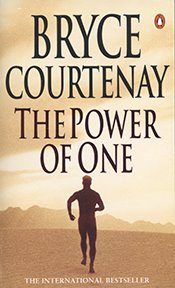
Our latest book club read was The Power of One by Bryce Courtenay. I know a couple of people who cite this as their favourite book of all time, and combined with the naked man featured on the cover, I was intrigued. I think that this book generated the most discussion yet in that there were disputes over the underlying motives of some characters, etc. I would say that while I enjoyed this book overall, I also had some major problems with it.

I was really enjoying the book at the beginning but slowly started getting more and more frustrated. So much shit happens to this poor kid that it just starts to become almost too much. I stated thinking "For Christ sake, will someone please just give this kid a sucker?". Fortunatley, someone does. But this heralds the beginning of the "too perfect" portion of the book. Peekay is brilliant, athletic and can do no wrong. But what bothered me the most may be due to my own flaws and short comings. It seemed like all the lessons he learned were by things that happened around him or to him, not through things that he did himself. For example, the major theme of the book is his disdain for racism and his emergence as the Tadpole Angel - chief of all tribes. But he learned this hate for racism from watching and never partaking. Isn't it likely that at some point in his life he would have succumbed to peer pressure and used a racial slur or put someone down? And perhaps his regret of this moment would help to shape his future opinions? How likely is it that in an environment like 1930s South Africa, a kid would never falter in his views? While I was pondering this I was remebering one of my own experiences. In middle school everyone picked on this one obese girl. Since everyone else was doing it, I got pressured in to joining in and eventually shouted "Tremor!" as she walked by and mimiced the ground shaking beneath her feet. I immediately felt awful. Ever since then I've been painfully aware that you choose how you treat people. Does everyone have an experience like this or am I composed of particularly weak moral character? It seemed that an incident like this would have made Peekay's morality more believable for me.

We also hotly debated the character of Geel Piet - a black prisoner who acts as Peekay's first boxing coach. My impression of Geel was that while he was fond of Peekay, he was a product of the prison system. He had never learned to trust and in turn was not trustworthy. The prison had taught him to always leave your true self hidden. As I was reading, there were a couple phrases that made me think Peekay saw this too, and that his observation of this was one of the lessons he learned. The idea that people are shaped by their environment and how they're treated. But some of the girls in the book club didn't see it this way at all. I guess that's the beauty of books - different people get different things out of the books.

Now here comes the ranting. While I admit that this wasn't my favourite book ever, i have developed a relationship with it over the last couple weeks and respect the story for what it is. Perhaps this is the reason that I felt so personally offended when we rented the 1992 movie version of the Power of One. I understand that it is sometimes not possible to fit every phrase and event of a book into a movie, but should one not at least attempt to maintain the spirit of the book?! They even changed what the "power of one" is! They completely eliminated the character that singly handedly provided Peekay with both his single obsessive ambition as well as his lifelong personal mantra - "First with the head, then with the heart." Then, and this is the truly horrible part, then they added a love interest and killed her off to fuel Peekay's motivation (and also some war/fight that didn't make any sense....I dunno I was not paying attention and fairly far down the road to drunk at this point)! That absolutely ruins the point of what Peekay was all about. So singular was his goal to be boxing champion that he never would have let a girl get in the way (he sees her while he's boxing, which results in his knock down - stupidity!). His lifelong nemesis is a guy named "the Judge" who tortures Peekay as a child and the culmination of this occurs in the final pages of the book when Peekay meets him again. No mention of this in the movie. In fact, the torturing at the hands of the Judge seems inconsequential, especially when you consider that it was the major driving force behind the rest of his life. The move barely takes the time to establish relationships so you never understand why the death of Granpa Chook or Geel Piet would even be significant and I didn't even notice if they bothered to kill off Doc!

What is the point of making a book into a movie if you so severely alter the spirit of it, that it becomes almost unrecognizable?! Did they even read the book? Lesson learned though, renting the movie is NOT the same as reading the book ;)

Sunday, August 27, 2006


I'm enjoying reading again.

Strangely fantasy got me out of my reading rut. A customer from the store lent me Dragon Prince Book 1 by Melanie Rawn. He bought it upon the recommendation of a Chapters employee and asked me to check it out. He wanted to make sure that it wasn't "mushy." It was. Reading it I couldn't help but picture the employee as a overly romantic 16 year old girl. And I had forgotten all the sex bits that fantasy tends to have and had a couple great giggles over Rawn's sketchs of her protagonist's eager penis. And sadly for John though, the customer, it had nothing to do with dragons. But I enjoyed reading something as nothing more than a story. **Big breath in** I'm also reading Mary Queen of Scotland and the Isles for the same reason. Historical fiction has penises too; although they're usually 'flaccid' and old. Not eagar and embarrassing. Penises! They're everywhere.

Also in the middle of reading The Vinyl Cafee Unplugged - one of 5 McLean's books courtesy of Kim's dad. I'm mixed about his books. The Dave stories are hilarious to me for the same reason that I enjoy Everyone Loves Raymond (as none of my cynical friends do) and Tool Time. It's the clueless man schtick and family stories I enjoy. Maybe I'm secretly into clueless men. Hmm. McLean's nostalgic sketches of Canada as small town aren't engaging though. I can't relate to small town stories about that day twenty years ago when the taps at the old pub failed and everyone got free beer. And I'm not sure what it means that it is so popular south of the border.

And today? Today, I treated myself to some shopping therapy regardless of my promise to finish the 30-to-reads lining my shelf. And instant happiness!

Although my quest to find "Twentisomething essays" (a fortitious title kara!!) was thwarted, I wandered around and in another fortitious turn found a book of Bukowski's poetry, The Flash of Lighting behind the Mountain. It's exciting b/c it's style is like mine (if I can be so bold) and b/c I loved the irreverance of Post Office (ah-ha, MORE penises!). I also found Junk Mail, a book of Will Self's non-fiction, and I'm loving it.

Afterthought: Another rambly pointless post.

Synopsis: I've become bogged down by all this seriousness. Getting back to irreverance. Loving my new books and trying to get my shit together.

Tuesday, August 22, 2006

www.seedmagazine.com/news/2006/08/thank_you_for_polluting.php

Eileen... Can you give this a read? What are your opinions on peer review as the absolute catch-all for 'Good Science' as that Gibbon's guy seems to believe?

(I'm thinking about your description of funding meetings as power games.)

Politics and politicking in science isn't a new thing. So many conflicts between science and government/religion spring to mind that it's dizzying.

Wednesday, August 02, 2006

A lot of people have read this book. In fact, most people I know have. There is little original revelation that I can share. All I can say is I enjoyed it - a lot. From the perspective of someone who is reading to get inspired to write, this book made me really want to have something to say. It wasn't the anti-racist message that touched me, but the quiet pleasure of the children's lives. The details of their day to day living I found beautiful and fun.

There could be no Tom Robinson in this book and no Bob Ewell, and I think I would have gotten the message loud and clear just from the lives and interactions of the characters. If I wanted to complain about anything, I'd make Atticus less perfect. But that can be forgiven since it is from a loving daughter's perspective.

This book goes to show, I guess, that good writing is in the small things, not necessarily in the big.

Tuesday, July 25, 2006


Middlesex by Jeffrey Eugenides

This was our lastest book club pick and it was fantastic. Everyone loved it. Its been a long time since I've read a book that I'd rather read than watch tv, but I couldn't put this one down. The narrator is a hermaphrodite that is raised as a girl then at puberty discovers, she's actually a guy. But the majority of the book isn't even about the narrator - it traces the origins of the mutation in his family starting with the grandparents and following it through to his/her birth. The story starts in Greece as the grandparents are forced to flee burning Smyrna, then moves to Detroit.

While the story itself is unique and captivating, one of the things I liked best about the book is the way its written. For instance, the emphasis of the characters in the book kind of mimics life. There isn't a sharp point where the book is suddenly about the next generation, it just flows so that by the end the grandparents have moved into a guest house on the family's property and are almost forgotten by both the family and the reader.

Anyway, its a fantastic read - just don't let the incest turn you off!

Tuesday, July 18, 2006

The Man Who Folded Himself Short sci-fi book. Quickly ponders the multi-problems of time-travel and the paradoxes associated with it. The paradoxes are handled well with a lot of interesting discussion about how he's "eliminated himself from the timeline" or messed with the time.

It's been a while since I've read Sci-Fi, and I liked this - although I found the relationships awkward. But, maybe I'm not the audience for those relationships.

I need something to read next. What to read? What to read. . .

Thursday, July 13, 2006

Just finished reading "Surely You're Joking, Mr. Feynman" a memoir in vignette form from Richard Feynman - Nobel Winner for Physics and crazy-mother-fucker.

He's the kind of man I've met (at least in part) in Math a few times. He's the kind of guy who understands the world very analytically and has no patience for arguments or people who don't have logical reasons for doing what they do. He's incredibly intelligent and because he doesn't get extraneous stuff (like the arguments of some philosophers who use overly technical words instead of just speaking clearly and some artists).

But what really stuck out for me was the way he really went for everything. He didn't know how to draw, so when he met an artist he really liked he asked him to teach him. And he practised constantly, took extra lessons and eventually got good enough to draw people's portraits. And it's like that with everything he did; with the physics obviously, but with everything else too, drums, safe-cracking, biology.

A great line from the book is "Of course I would like to have done it at home, and I don't doubt that you could meditate and do [hallucinate] it if you practice, but I didn't practice." This is regarding duplicating an experience he had in a sensory deprivation chamber. For him it is his great failing that he didn't practice.

Having read the book, I now really want to do something - anything - and do it really well. Practising all the time and to really be a well rounded and interesting individual.

I highly recommend this book to anyone who feels like they can't do anything. You'll be inspired.

It's also INCREDIBLY funny and his complete lack of social grace gets him into many a ridiculous adventure.

Saturday, July 01, 2006

Reading Paul Auster

I'm trying to read but current circumstances aren't conducive to the mental state required by the process. That said, I'm making my way lazily through a few books.

Abott's A History of Mistresses (the history of celebacy was decent), Guibert's to the friend who did not save my life, and Paul Auster's "glass city" from his trilogy.

Strangely, reading Auster has given me the most satisfaction and I've managed to keep reading. It's my second attempt to read, what has been introduced to me as, a 'typically male' text. This description is bizarre to me and brings to mind all the fallacies of definition. Ondaatje isn't male? Coleman sees it as male. Although to them, it's less about the penis and more about masculinity. Less trance-like - like Quinn's description of making his own appointment as Auster - and a more deliberate observation or experiment.

Contemporary male texts that are very aware of the 'penis' are new to me and generally make me laugh. I'm aware I am missing some of the experience intended by the author in the same way that I don't let out a sympathetic groan when a man gets kicked in the groin. I don't really understand the literary or experiential purpose of describing a moment of fear by a "penis gone limp." In the same way, I don't understand the comfort of big boobs for the narrator of the postal service. That said, I do enjoy it and will continue.

I can feel a comparison between these so very American texts and, for example, my favourite postcolonial, Ondaatje's, Canadian (Coleman's Masculine Migrations) books coming on. A comparison between Auster and Hawthorne seem to keep happening in my mind as well.

to be continued.

Wednesday, June 21, 2006

I've been thinking alot about writing lately. And relatedly, what people want to read. (An extension being, what types of people read certain books.)

Extremely self-conscious about my position wrt text and preoccupied with thoughts about writing I have realized that all this thinking is my attempt to reconcile how to first represent my own style.

As an aside: I have forced myself to begin a book. It's called "to the friend who did not save my life" and was written by a French author and journalist, Herve Guibert (forgive the lack of accents, I haven't learned the strokes for it yet). You can find a blurb about it on most glbt websites.

Anyways, tired of staring at my books and not interested in testing this mood out on a less experimental book, I started it a couple of days ago and have managed 3 pages and 4 chapters.

Returning to style: Kara's posts and past conversations with Kim and Eileen - the few friends I have who continue to read outside of school - as well as my mental state of late and reading guibert's book has led me ask the question that has always preoccupied me: WHY DOES ONE READ?

I get the sense that kara is most comfortable reading work that she can relate to whether it be 'real' or via fantasy. I think she posted as much. Others read to gain new knowledge (a problem...). Some read for entertainment, some read for sexual thrill. And so on, to various degrees.

For me, there are no limits. I have themes that I'm interested in, genres, periods etc. yes but the element that does more than attracts, and draws me in, is style. Particularly poetic style. There is something about this demystifying language that has come to define the best literary work for me.

Guibert's style is disconcerning and I hate it. So far there is no poetry. But this I'll leave for another entry.

The point that started all these tangents, is my question to you. WHY DO YOU READ? Please write.

Saturday, June 17, 2006


Michael Ondaatje is a great writer. I know this because everyone says so. I also know this because when I read The English Patient in school the essays I wrote were the easiest to write ever - easy to find complexities.

That said, I think there is always a sense of otherworldliness to his writing. I have this sense that the characters are very water color - complex, colorful but intangible. This became very clear to me when I was reading In The Skin of a Lion. There was something so unreal about it. The language is so beautiful, it's just not representative of the way I experience the world.

So, after 54 pages, I found I stopped reading it.


Now I'm reading Volkswagen Blues. Simple, clear, fun. The events are unlikely but real. I'm really enjoying it.

Sunday, June 04, 2006

Who votes to go public?
(That means that others on the internet will be able to 'search' for this site.)

And who votes to stay private?
(Meaning this site does not show up on our profiles.)
I'd forgotten that I was supposed to post my opinion of my book club books on here. Luckily I remembered, just in time to avoid studying....Our last pick was The Curious Incident of the Dog in the Nighttime by Mark Haddon, and I did not enjoy it. I read it because several people had recommended it. While I understand that the writing style is because the narrator is an autistic kid, I just didn't enjoy a book written that way - though it certainly made it a quick read. I also found that I was totally indifferent to the story until about 3/4 of the way through with all the drama about his mother. But then...just as I was starting to like it, it ended. Very abruptly in my opinion.The rest of the book club liked it for various reasons. One girl really liked it because a friend of her family has a kid that was just diagnosed with autism and she thought the book was revealing. But to be honest, the book is so simple that we really didn't have much discussion about it. (yeah, yeah Maxie...I know you told me so)Our next book is Middle sex (can't remember the author right now) recommended to me by my future sister-in-law, about a hermaphrodite....I'll let you knwo how that one is.

Sunday, May 28, 2006

Ok, so has anyone read Don Quixote? I'm totally sick of these "Windmill" references. I get that in the novel Quixote attacked windmills, but since this is the most ridiculous notion I've ever heard of I figure there has to be a point, right? Or is there no point? Or am I over complicating things?

All I know is, there is no reason in this day and age for anyone anywhere to talk about windmills except in reference to this novel. Everyone stop it already! Was it on your reading list in high school? Was it some kind of right-of-passage? Why must everyone keep talking about Windmills?

Friday, April 28, 2006

Damn this wordiness that I've been cursed with.

I am completely demoralized. Stupid essays, stupid deadlines.

Although, overall, they aren't 'really' important, you can see I had to qualify 'important.' Because really (no quotation marks) they are.

2 days and counting.