Tuesday, July 25, 2006


Middlesex by Jeffrey Eugenides

This was our lastest book club pick and it was fantastic. Everyone loved it. Its been a long time since I've read a book that I'd rather read than watch tv, but I couldn't put this one down. The narrator is a hermaphrodite that is raised as a girl then at puberty discovers, she's actually a guy. But the majority of the book isn't even about the narrator - it traces the origins of the mutation in his family starting with the grandparents and following it through to his/her birth. The story starts in Greece as the grandparents are forced to flee burning Smyrna, then moves to Detroit.

While the story itself is unique and captivating, one of the things I liked best about the book is the way its written. For instance, the emphasis of the characters in the book kind of mimics life. There isn't a sharp point where the book is suddenly about the next generation, it just flows so that by the end the grandparents have moved into a guest house on the family's property and are almost forgotten by both the family and the reader.

Anyway, its a fantastic read - just don't let the incest turn you off!

Tuesday, July 18, 2006

The Man Who Folded Himself Short sci-fi book. Quickly ponders the multi-problems of time-travel and the paradoxes associated with it. The paradoxes are handled well with a lot of interesting discussion about how he's "eliminated himself from the timeline" or messed with the time.

It's been a while since I've read Sci-Fi, and I liked this - although I found the relationships awkward. But, maybe I'm not the audience for those relationships.

I need something to read next. What to read? What to read. . .

Thursday, July 13, 2006

Just finished reading "Surely You're Joking, Mr. Feynman" a memoir in vignette form from Richard Feynman - Nobel Winner for Physics and crazy-mother-fucker.

He's the kind of man I've met (at least in part) in Math a few times. He's the kind of guy who understands the world very analytically and has no patience for arguments or people who don't have logical reasons for doing what they do. He's incredibly intelligent and because he doesn't get extraneous stuff (like the arguments of some philosophers who use overly technical words instead of just speaking clearly and some artists).

But what really stuck out for me was the way he really went for everything. He didn't know how to draw, so when he met an artist he really liked he asked him to teach him. And he practised constantly, took extra lessons and eventually got good enough to draw people's portraits. And it's like that with everything he did; with the physics obviously, but with everything else too, drums, safe-cracking, biology.

A great line from the book is "Of course I would like to have done it at home, and I don't doubt that you could meditate and do [hallucinate] it if you practice, but I didn't practice." This is regarding duplicating an experience he had in a sensory deprivation chamber. For him it is his great failing that he didn't practice.

Having read the book, I now really want to do something - anything - and do it really well. Practising all the time and to really be a well rounded and interesting individual.

I highly recommend this book to anyone who feels like they can't do anything. You'll be inspired.

It's also INCREDIBLY funny and his complete lack of social grace gets him into many a ridiculous adventure.

Saturday, July 01, 2006

Reading Paul Auster

I'm trying to read but current circumstances aren't conducive to the mental state required by the process. That said, I'm making my way lazily through a few books.

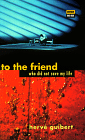
Abott's A History of Mistresses (the history of celebacy was decent), Guibert's to the friend who did not save my life, and Paul Auster's "glass city" from his trilogy.

Strangely, reading Auster has given me the most satisfaction and I've managed to keep reading. It's my second attempt to read, what has been introduced to me as, a 'typically male' text. This description is bizarre to me and brings to mind all the fallacies of definition. Ondaatje isn't male? Coleman sees it as male. Although to them, it's less about the penis and more about masculinity. Less trance-like - like Quinn's description of making his own appointment as Auster - and a more deliberate observation or experiment.

Contemporary male texts that are very aware of the 'penis' are new to me and generally make me laugh. I'm aware I am missing some of the experience intended by the author in the same way that I don't let out a sympathetic groan when a man gets kicked in the groin. I don't really understand the literary or experiential purpose of describing a moment of fear by a "penis gone limp." In the same way, I don't understand the comfort of big boobs for the narrator of the postal service. That said, I do enjoy it and will continue.

I can feel a comparison between these so very American texts and, for example, my favourite postcolonial, Ondaatje's, Canadian (Coleman's Masculine Migrations) books coming on. A comparison between Auster and Hawthorne seem to keep happening in my mind as well.

to be continued.

Wednesday, June 21, 2006

I've been thinking alot about writing lately. And relatedly, what people want to read. (An extension being, what types of people read certain books.)

Extremely self-conscious about my position wrt text and preoccupied with thoughts about writing I have realized that all this thinking is my attempt to reconcile how to first represent my own style.

As an aside: I have forced myself to begin a book. It's called "to the friend who did not save my life" and was written by a French author and journalist, Herve Guibert (forgive the lack of accents, I haven't learned the strokes for it yet). You can find a blurb about it on most glbt websites.

Anyways, tired of staring at my books and not interested in testing this mood out on a less experimental book, I started it a couple of days ago and have managed 3 pages and 4 chapters.

Returning to style: Kara's posts and past conversations with Kim and Eileen - the few friends I have who continue to read outside of school - as well as my mental state of late and reading guibert's book has led me ask the question that has always preoccupied me: WHY DOES ONE READ?

I get the sense that kara is most comfortable reading work that she can relate to whether it be 'real' or via fantasy. I think she posted as much. Others read to gain new knowledge (a problem...). Some read for entertainment, some read for sexual thrill. And so on, to various degrees.

For me, there are no limits. I have themes that I'm interested in, genres, periods etc. yes but the element that does more than attracts, and draws me in, is style. Particularly poetic style. There is something about this demystifying language that has come to define the best literary work for me.

Guibert's style is disconcerning and I hate it. So far there is no poetry. But this I'll leave for another entry.

The point that started all these tangents, is my question to you. WHY DO YOU READ? Please write.

Saturday, June 17, 2006


Michael Ondaatje is a great writer. I know this because everyone says so. I also know this because when I read The English Patient in school the essays I wrote were the easiest to write ever - easy to find complexities.

That said, I think there is always a sense of otherworldliness to his writing. I have this sense that the characters are very water color - complex, colorful but intangible. This became very clear to me when I was reading In The Skin of a Lion. There was something so unreal about it. The language is so beautiful, it's just not representative of the way I experience the world.

So, after 54 pages, I found I stopped reading it.


Now I'm reading Volkswagen Blues. Simple, clear, fun. The events are unlikely but real. I'm really enjoying it.

Sunday, June 04, 2006

Who votes to go public?
(That means that others on the internet will be able to 'search' for this site.)

And who votes to stay private?
(Meaning this site does not show up on our profiles.)